

Close Menu
  • News
      • Appointments
      • EV Powertrain
      • Emissions
      • Engine Components
      • Electronics
      • Facility Developments
      • Forced Induction
      • Fuel Cell Technologies
      • Fuels & Lubricants
      • Heavy-duty & Diesel Engine Technologies
      • Hybrid Powertrain Technologies
      • Industry Forecasting
      • Legislation
      • Materials & Surface Treatment
      • Metallurgy
      • Mild-hybrid & 48V Technologies
      • New powertrain
      • Partnerships, Investments & Acquisitions
      • Quality Control
      • Prototyping
      • Sustainable fuels
      • Testing
      • Traction Control Systems
      • Transmissions Technologies
      • Webinars
  • Features
  • Online Magazines
    • April 2026
    • January 2026
    • September 2025
    • June 2025
    • March 2025
    • January 2025
    • September 2024
    • Subscribe to Automotive Powertrain Technology
    • Transmission Technology International
    • Subscribe to Transmission Technology
  • Opinion
  • Events
  • Supplier Spotlight
  • Webinars
Facebook X (Twitter) Instagram
  • Automotive Interiors
  • Automotive Testing
  • Autonomous Vehicle
  • Professional Motorsport
  • Tire Technology
  • Media Pack
LinkedIn
Subscribe
Automotive Powertrain Technology International
  • News
      • Appointments
      • EV Powertrain
      • Emissions
      • Engine Components
      • Electronics
      • Facility Developments
      • Forced Induction
      • Fuel Cell Technologies
      • Fuels & Lubricants
      • Heavy-duty & Diesel Engine Technologies
      • Hybrid Powertrain Technologies
      • Industry Forecasting
      • Legislation
      • Materials & Surface Treatment
      • Metallurgy
      • Mild-hybrid & 48V Technologies
      • New powertrain
      • Partnerships, Investments & Acquisitions
      • Quality Control
      • Prototyping
      • Sustainable fuels
      • Testing
      • Traction Control Systems
      • Transmissions Technologies
      • Webinars
  • Features
  • Online Magazines
    1. April 2026
    2. January 2026
    3. September 2025
    4. June 2025
    5. March 2025
    6. January 2025
    7. September 2024
    8. Subscribe to Automotive Powertrain Technology
    9. Transmission Technology International
    10. Subscribe to Transmission Technology
    Featured

    In this Issue – April 2026

    By Web TeamMay 1, 2026
    Recent

    In this Issue – April 2026

    May 1, 2026

    In this Issue – January 2026

    December 3, 2025

    In this Issue – September 2025

    September 25, 2025
  • Opinion
  • Events
  • Supplier Spotlight
  • Webinars
LinkedIn Facebook
Subscribe
Automotive Powertrain Technology International
Battery technology

Electrode-to-pack by 24M increases EV driving range by 33%

Zahra AwanBy Zahra AwanOctober 1, 20253 Mins Read
LinkedIn Twitter Facebook Email
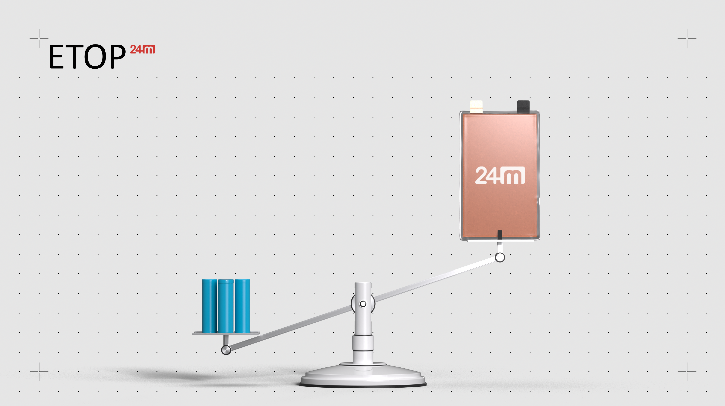
24M ETOP (Electrode-to-Pack).
Share
LinkedIn Twitter Facebook Email

24M Technologies has developed a battery packing system that can increase EV driving range by up to 50%. 24M ETOP (Electrode-to-Pack) features technology that seals electrodes in thin polymer films that are then integrated directly into the pack to vastly improve packaging efficiencies.

Currently, battery manufacturers and car makers build modules and packs from individual cells meaning that lithium-ion batteries feature a large proportion of inactive, non-energy-carrying materials – such as supporting metals and plastics – within a cell’s casing, adding cost and wasting space.

24M ETOP replaces this approach by creating a sealed cathode/anode pair that eliminates the cell and module and unnecessary materials. This allows manufacturers to achieve the highest energy density for any chemistry (NMC, LFP, NCA, sodium-ion, LTO, LiS) available at the pack level, because a higher percentage of the battery is electrodes, the energy-storing components.

The ETOP solution enables electrodes to comprise 80% of a pack’s volume, compared to the 30% to 60% of traditional battery packs. This offers customers improved EV ranges by packing more energy into the same-sized pack or reducing EV costs by using less expensive chemistries.

For example, a 75kWh NMC (nickel manganese cobalt) battery – the size and type used by many mid-sized electric vehicles – with 24M ETOP could be increased to 100kWh using the same chemistry, increasing range by 33% within the same-sized pack. ETOP enables manufacturers to swap NMC chemistry for less expensive LFP (lithium-iron phosphate) technology, resulting in a less costly pack, but with the same overall range.

The ETOP features a design flexibility that enables completely customizable battery packs in different voltages and virtually any shape. OEMs and designers can create shapes such as ovals and hexagons.

Naoki Ota, President and CEO at 24M Technologies.
Naoki Ota, president and CEO, 24M Technologies

The solution aims to ease manufacturing. With the electrodes sealed individually, electrode safety tolerances do not have to be as tight as in a traditional battery, improving yield and safety while reducing investment costs by eliminating the need for traditional high-tolerance and precision equipment. Because the sealed electrodes can be flipped, they can be connected in series and parallel arrangements, enabling anything from a compact 48V battery all the way up to a mixed series/parallel 400-800V pack, giving battery designers further freedom. ETOP also enables cell formation to be done in series which can reduce formation equipment investment.

Naoki Ota, president and CEO at 24M Technologies, said, “Minimizing packaging materials and wasted space, 24M ETOP brings a step change in performance, replacing traditional cell-to-module-to-pack construction with electrode-to-pack construction, maximizing energy density.” He continued, “24M ETOP makes it easier to build compact, flexible and safe high-voltage batteries, presenting a revolutionary opportunity for electric vehicle manufacturers – longer ranges with the same chemistry or the same range with lower cost, safer chemistries, both in the same space. It truly is the closest version of an ideal battery – it is essentially all active material in a sophisticated wrapper.”

24M ETOP can also be used with 24M’s Impervio separator, Eternalyte electrolyte, and its LiForever electrode, all of which are aimed at creating a fundamentally safer, higher performing and longer-lived battery through the reimagination of internal battery design.

In related news, SK On launches all-solid-state battery pilot plant ahead of 2029 rollout

Share. LinkedIn Twitter Facebook Email

Related Posts

Gen6 battery cell technology reduces BMW’s CO₂e footprint

April 16, 2026

Advanced cylindrical cell battery technology powers next-generation electric BMW i7

April 7, 2026

University of Surrey develops lithium-ion battery anode that delivers increased energy storage

April 1, 2026
LATEST NEWS

Renault introduces LPG bi-fuel Clio that delivers up to 1,450km range

May 7, 2026

UK consortium secures funding for ReCAM lithium-ion battery recycling project

May 7, 2026

BorgWarner wins turbocharger contracts with two European OEMs

May 7, 2026

Receive breaking stories and features in your inbox each week, for free


Enter your email address:


Supplier Spotlights
  • Tula Technology
Featured Listings
  • There are currently no listings to show.
Getting in Touch
  • Contact Us
  • Media Pack
  • Meet the Editors
  • Free Weekly E-Newsletter
Our Social Channels
  • LinkedIn
Related UKi Topics
  • Automotive Interiors
  • Automotive Testing
  • Autonomous Vehicle
  • Professional Motorsport
  • Tire Technology
  • Media Pack
© 2026 UKi Media & Events a division of UKIP Media & Events Ltd
  • Terms and Conditions
  • Privacy Policy
  • Cookie Policy
  • Notice and Takedown Policy

Type above and press Enter to search. Press Esc to cancel.