
Close Menu
  • News
      • Appointments
      • EV Powertrain
      • Emissions
      • Engine Components
      • Electronics
      • Facility Developments
      • Forced Induction
      • Fuel Cell Technologies
      • Fuels & Lubricants
      • Heavy-duty & Diesel Engine Technologies
      • Hybrid Powertrain Technologies
      • Industry Forecasting
      • Legislation
      • Materials & Surface Treatment
      • Metallurgy
      • Mild-hybrid & 48V Technologies
      • New powertrain
      • Partnerships, Investments & Acquisitions
      • Quality Control
      • Prototyping
      • Sustainable fuels
      • Testing
      • Traction Control Systems
      • Transmissions Technologies
      • Webinars
  • Features
  • Online Magazines
    • April 2026
    • January 2026
    • September 2025
    • June 2025
    • March 2025
    • January 2025
    • September 2024
    • Subscribe to Automotive Powertrain Technology
    • Transmission Technology International
    • Subscribe to Transmission Technology
  • Opinion
  • Events
  • Supplier Spotlight
  • Webinars
Facebook X (Twitter) Instagram
  • Automotive Interiors
  • Automotive Testing
  • Autonomous Vehicle
  • Professional Motorsport
  • Tire Technology
  • Media Pack
LinkedIn
Subscribe
Automotive Powertrain Technology International
  • News
      • Appointments
      • EV Powertrain
      • Emissions
      • Engine Components
      • Electronics
      • Facility Developments
      • Forced Induction
      • Fuel Cell Technologies
      • Fuels & Lubricants
      • Heavy-duty & Diesel Engine Technologies
      • Hybrid Powertrain Technologies
      • Industry Forecasting
      • Legislation
      • Materials & Surface Treatment
      • Metallurgy
      • Mild-hybrid & 48V Technologies
      • New powertrain
      • Partnerships, Investments & Acquisitions
      • Quality Control
      • Prototyping
      • Sustainable fuels
      • Testing
      • Traction Control Systems
      • Transmissions Technologies
      • Webinars
  • Features
  • Online Magazines
    1. April 2026
    2. January 2026
    3. September 2025
    4. June 2025
    5. March 2025
    6. January 2025
    7. September 2024
    8. Subscribe to Automotive Powertrain Technology
    9. Transmission Technology International
    10. Subscribe to Transmission Technology
    Featured

    In this Issue – April 2026

    By Web TeamMay 1, 2026
    Recent

    In this Issue – April 2026

    May 1, 2026

    In this Issue – January 2026

    December 3, 2025

    In this Issue – September 2025

    September 25, 2025
  • Opinion
  • Events
  • Supplier Spotlight
  • Webinars
LinkedIn Facebook
Subscribe
Automotive Powertrain Technology International
Features

Tech deep dive: Hyundai Continuously Variable Valve Duration

Alex GrantBy Alex GrantJanuary 1, 20214 Mins Read
LinkedIn Twitter Facebook Email
Tech deep dive: Hyundai Continuously Variable Valve Duration
Share
LinkedIn Twitter Facebook Email

Despite growing momentum behind electrification as a route to greater efficiency, Hyundai is still pursuing incremental improvements for its core powertrain technology. Further optimization is targeting 50% thermal efficiency using new technologies, and Dr Byoung-Hyouk Min, a powertrain engineer based at the company’s R&D center in Namyang, South Korea, stresses that there’s no single solution yet.

“Long-term stabilization of oil prices at a low level, limited charging infrastructure and gradual reduction of government incentives has slowed the attraction toward electric vehicles,” he comments. “For the future powertrain portfolio, expanding electric technologies is particularly important, but efficiency enhancement of conventional powertrains is also essential and will happen in parallel with electrification.”

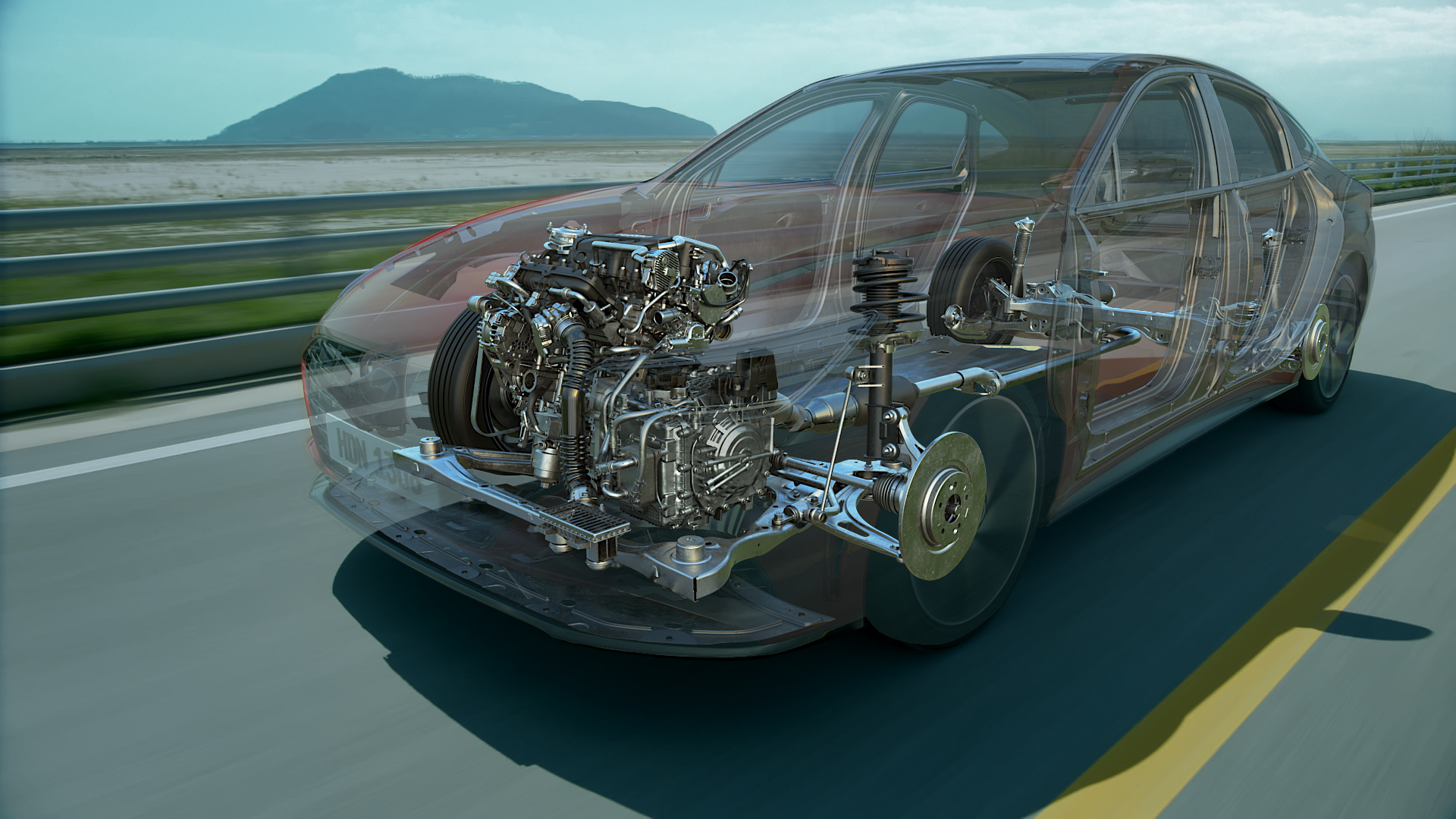
Continuously Variable Valve Duration (CVVD) is the latest tool in that arsenal, with Hyundai’s first four-cylinder gasoline applications launching this year. A claimed world-first, this is a proprietary technology that enables the inlet valve opening duration to be varied based on operating conditions. Min says this provides thermal efficiency akin to a long-duration Atkinson cycle unit at part throttle, but without the torque compromises under load.

“One of the main motivations behind the development of CVVD was to simplify the previous variable valve actuation system,” he explains. “The CVVD tech was invented with efficient kinematic working principles, so that it comprised a relatively small number of components resulting in better controllability and cost efficiency compared with conventional variable valve actuation systems.”

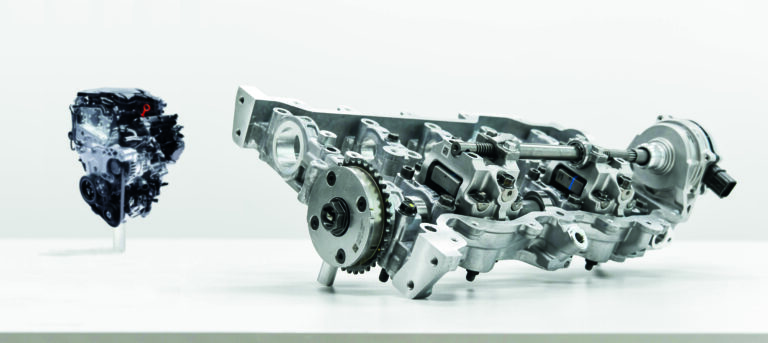
The system features individual cams for each cylinder and a separate camshaft, which are connected by pairs of sliding linkages within two wheels. These wheels are housed within mechanisms that slide at right angles to the shaft using a worm drive, actuated by a 140W electric motor fitted at the opposite end of the head to the timing chain. Offsetting the center point of the cam changes the lengths of the linkages, which in turn affects its rotational behavior relative to the shaft.

Sliding the mechanism in one direction slows the cam rotation as the lobe opens the valve, which lengthens the duration. Suited to low loads and constant speeds, this keeps the valve open from the beginning to almost the end of the compression stroke, which reduces pressure-related pumping losses and improves efficiency.

Under higher loads, the mechanism slides in the opposite direction, which rotates the lobe more quickly past the point where it opens the valve, and shortens the duration. In turn, this reduces the overlap from the previous combustion cycle and maximizes the inlet air within the cylinder, improving engine performance.
“Similar to the Atkinson cycle, the benefit of the CVVD system is that pumping loss reduction can be decreased in high load area, which is becoming more important due to the real-world driving homologation,” continues Min. “At full load the WOT torque throughout the engine speed region is significantly superior owing to the scavenging and the optimum valve duration. The low-end torque in particular could be improved by the shortened valve duration set.”

Because the lobe rotates at an inversely proportionate speed to the rest of the cam profile, the average rotating speed of the cam and shaft are identical, regardless of operating conditions. Min claims this offers a high degree of variation, of between 150° and 290° crank angle, with an effective compression ratio between 4:1 and 10.5:1. The system can also be used to promote quicker warm-up of the three-way catalyst, reducing harmful emissions on startup – particularly useful for stop/start systems and hybrids.

Planned applications are broad, including 48V mild hybrid and plug-in hybrid powertrains, which makes it an increasingly important asset as momentum grows behind electrification. Min continues, “Around 10% fuel economy improvements will be accomplished by the new Smartstream engines. These innovative powertrain designs will be the very first step toward Hyundai-Kia’s sustainable future powertrain strategy.”

Share. LinkedIn Twitter Facebook Email

Related Posts

Study reveals what EV buyers really ask about batteries

November 12, 2025

New self-assembling material could be the key to recyclable EV batteries

September 4, 2025

Hyundai/GM alliance powers forward with five all-new vehicles

August 12, 2025
LATEST NEWS

Renault introduces LPG bi-fuel Clio that delivers up to 1,450km range

May 7, 2026

UK consortium secures funding for ReCAM lithium-ion battery recycling project

May 7, 2026

BorgWarner wins turbocharger contracts with two European OEMs

May 7, 2026

Receive breaking stories and features in your inbox each week, for free


Enter your email address:


Supplier Spotlights
  • Johnson Electric
Featured Listings
  • There are currently no listings to show.
Getting in Touch
  • Contact Us
  • Media Pack
  • Meet the Editors
  • Free Weekly E-Newsletter
Our Social Channels
  • LinkedIn
Related UKi Topics
  • Automotive Interiors
  • Automotive Testing
  • Autonomous Vehicle
  • Professional Motorsport
  • Tire Technology
  • Media Pack
© 2026 UKi Media & Events a division of UKIP Media & Events Ltd
  • Terms and Conditions
  • Privacy Policy
  • Cookie Policy
  • Notice and Takedown Policy

Type above and press Enter to search. Press Esc to cancel.