
Ben Gale, technical sales engineer at Horiba MIRA, provides an overview of the commercial vehicle market and the challenges that face the industry, in particular battery testing and the future requirements of fleet managers as emission regulations tighten.
The future of electrification is reliant on optimization, both in respect to commercial and passenger vehicles. Passenger vehicle manufacturers have been key to the increased uptake of electrification, with last year being the first time electric vehicle sales surpassed the million-unit mark.
The commercial vehicle sector, however, has been slower on the uptake – though this is now changing. At this year’s major trade shows, nearly every OEM and Tier 1 supplier announced zero-emission and low-emission powertrains. While it is clear the industry is keen to push forward with electrification, the horizon isn’t completely clear, with the challenge of range still to be dealt with.
Currently, OEMs are seeking to increase the energy available within their fleets to improve range and battery efficiency – but this means the need for increased battery capacity and energy optimization. In order to achieve this, OEMs rely heavily on cell chemistry improvements to aid the energy and power density of their battery packs.
Another option to improve energy levels in batteries is to look at how efficiently the system or fleet operates. As the cell chemistry becomes more energy dense, the requirements for greater levels of safety and state-of-the-art cooling systems grow.
Furthermore, long-term issues such as material sustainability, packaging and recyclability must take center stage as the industry manages the transition from internal combustion engines to hybrid and electric vehicles.
Horiba MIRA engineers are tackling this head on with a focus on total energy management, including thermal system simulation control and system development both for powertrain and battery technology.
Furthermore, capabilities in the development and validation of electrified vehicles have increased following Horiba’s acquisition of battery and fuel cell application expert FuelCon. The deal provides a comprehensive service offering for developing and validating increasingly complex powertrains and future powertrain technologies. This is particularly important in terms of fulfilling the increased global demand for e-mobility solutions and providing OEMs with the latest technologies to help globalize the concept of electrical commercial vehicles.
The emphasis on battery range presents many challenges, one of which is understanding the actual performance and characteristics of the individual cells used within the battery pack. Horiba MIRA is carrying out such activities at extremely high resolution and accuracy using the Advanced Battery Development Suite (ABDS). The company’s ability to characterize cell performance via ABDS enables it to push the performance boundaries and increase levels of usable energy (and consequently EV range).
The ABDS facility is also used to investigate the details of cell aging mechanisms and how to keep cells within the ‘sweet spot’ – thus lowering the degradation and increasing the durability of these cells.
It can be expected that as electric assistance increases, the reliance on diesel-powered engines will fade, however they won’t be completely phased out as there will likely always be a long-term need for diesel-powered vehicles.
This is most relevant for heavy-load fleets on long-haul, suburban journeys where current lithium-ion technology will not get drivers effectively from A to B. Therefore, the initial focus for commercial vehicle fleet managers is to reduce vehicle emissions in towns and cities, areas that continue to emphasize the importance of implementing low-emission driving zones.
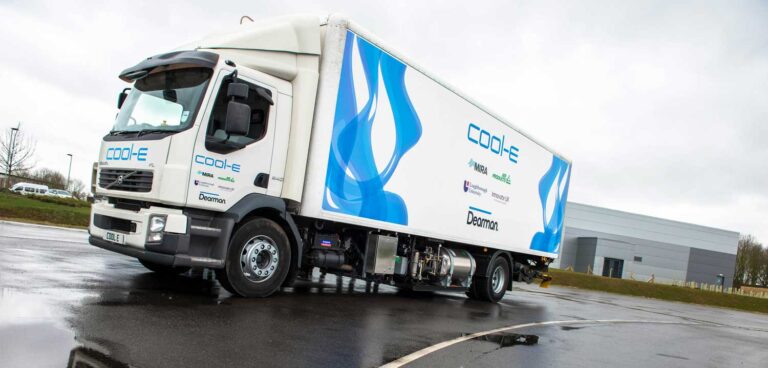
More work is required to understand the viability of electrically powered commercial vehicles, therefore it is possible we will see OEMs replacing/supplementing diesel-powered engines to enable longer haul applications and low-emission powertrains. Currently there are multiple options available for development, such as natural gas, chemical batteries and hydrogen fuel cells.
The current spread of technologies allows many lines of development, however as the field begins to narrow we will see technologies rise and fall in popularity. Horiba MIRA is working with OEMs to understand the viability of these options, ensuring commercial vehicle engines are powered by efficient fuels and technologies.
While public and commercial uptake continues to grow, OEMs face the pressure of delivering ultra-low emission vehicles in line with government regulations. Therefore, many of them are turning to hybrids – a propulsion mix of combustion and electric power.
The immediate advantage of hybrids and one that responds to increasingly stringent emissions regulations is that they consume less fuel and produce fewer emissions by utilizing and capturing electrical energy.
With advancements being made to improve the effectiveness of hybrid commercial vehicles, the next decade will likely see a mix of diesel, hybrid and fully electric commercial vehicles on our roads. How this electrical energy is stored is still to be answered.