

Close Menu
  • News
      • Appointments
      • EV Powertrain
      • Emissions
      • Engine Components
      • Electronics
      • Facility Developments
      • Forced Induction
      • Fuel Cell Technologies
      • Fuels & Lubricants
      • Heavy-duty & Diesel Engine Technologies
      • Hybrid Powertrain Technologies
      • Industry Forecasting
      • Legislation
      • Materials & Surface Treatment
      • Metallurgy
      • Mild-hybrid & 48V Technologies
      • New powertrain
      • Partnerships, Investments & Acquisitions
      • Quality Control
      • Prototyping
      • Sustainable fuels
      • Testing
      • Traction Control Systems
      • Transmissions Technologies
      • Webinars
  • Features
  • Online Magazines
    • April 2026
    • January 2026
    • September 2025
    • June 2025
    • March 2025
    • January 2025
    • September 2024
    • Subscribe to Automotive Powertrain Technology
    • Transmission Technology International
    • Subscribe to Transmission Technology
  • Opinion
  • Supplier Spotlight
  • Webinars
Facebook X (Twitter) Instagram
  • Automotive Interiors
  • Automotive Testing
  • Autonomous Vehicle
  • Professional Motorsport
  • Tire Technology
  • Media Pack
LinkedIn
Subscribe
Automotive Powertrain Technology International
  • News
      • Appointments
      • EV Powertrain
      • Emissions
      • Engine Components
      • Electronics
      • Facility Developments
      • Forced Induction
      • Fuel Cell Technologies
      • Fuels & Lubricants
      • Heavy-duty & Diesel Engine Technologies
      • Hybrid Powertrain Technologies
      • Industry Forecasting
      • Legislation
      • Materials & Surface Treatment
      • Metallurgy
      • Mild-hybrid & 48V Technologies
      • New powertrain
      • Partnerships, Investments & Acquisitions
      • Quality Control
      • Prototyping
      • Sustainable fuels
      • Testing
      • Traction Control Systems
      • Transmissions Technologies
      • Webinars
  • Features
  • Online Magazines
    1. April 2026
    2. January 2026
    3. September 2025
    4. June 2025
    5. March 2025
    6. January 2025
    7. September 2024
    8. Subscribe to Automotive Powertrain Technology
    9. Transmission Technology International
    10. Subscribe to Transmission Technology
    Featured

    In this Issue – April 2026

    By Web TeamMay 1, 2026
    Recent

    In this Issue – April 2026

    May 1, 2026

    In this Issue – January 2026

    December 3, 2025

    In this Issue – September 2025

    September 25, 2025
  • Opinion
  • Supplier Spotlight
  • Webinars
LinkedIn Facebook
Subscribe
Automotive Powertrain Technology International
Metallurgy

Nissan and Waseda refine co-development of recycling process for EV motors

Callum Brook-JonesBy Callum Brook-JonesSeptember 6, 20212 Mins Read
LinkedIn Twitter Facebook Email
Share
LinkedIn Twitter Facebook Email

Nissan and the Japanese Waseda University say they have begun testing and co-developing a recycling process that aims to recover high-purity rare earth compounds from EV motor magnets.

With many EV motors utilizing rare earth materials, the evolution of the recycling process is seen as an important step to aid in reducing the environmental impacts associated with mining and refining operations. As the balance of supply and demand for the rare materials shifts, this can also lead to prices rising or falling.

The first successful pyrometallurgy process was developed by the partnership in March 2020 and negates the need to disassemble EV motors before recovering REEs.

At present, the testing phase has shown that 98% of REEs from the EV motors can be recovered. The latest process is also around 50% quicker than the current method as magnets don’t have to be demagnetized, disassembled or removed.

Both companies will continue to develop the process for practical application, and Nissan will continue to collect metals from the EV recycling process to further develop the company’s recycling system. The duo hopes to begin using the process by the middle of the decade.

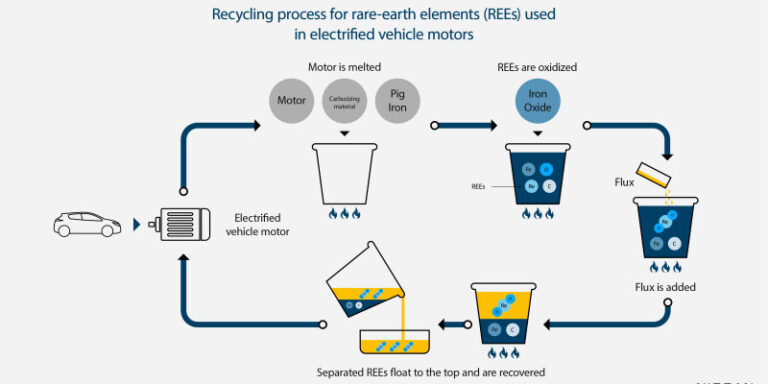
The process works by adding carburizing material and pig iron to the motor, which is then heated to a melting point of 1,400˚C. Iron oxide is added to oxidize REEs in the molten mixture. A small amount of borate-based flux is then placed into the mixture to dissolve the rare earth oxides at a low temperature. This borate-based flux is also highly efficient at recovering REEs.

As a result of the process, the molten mixture then separates into two layers, a molten oxide layer (slag) that contains the REEs at the top, and a high-density iron-carbon (Fe-C) alloy at the bottom. The REEs are then recovered.

Share. LinkedIn Twitter Facebook Email

Related Posts

World’s first valve seat using cold spray technology used in latest Nissan’s powertrain

August 28, 2025

Researchers develop ML model for permanent magnet material discovery 

September 8, 2023

How a novel sealing plug and process control reduced wastage rates of transmission casings

June 1, 2023
LATEST NEWS

TotalEnergies and Stellantis expand engine oil partnership

May 29, 2026

Mercedes‑AMG presents all-electric GT 4‑Door Coupe

May 21, 2026

Under the hood of the Porsche 911 Carrera Coupe and Cabriolet Reimagined by Singer

May 21, 2026

Receive breaking stories and features in your inbox each week, for free


Enter your email address:


Supplier Spotlights
  • Hillcrest
Featured Listings
  • There are currently no listings to show.
Getting in Touch
  • Contact Us
  • Media Pack
  • Meet the Editors
  • Free Weekly E-Newsletter
Our Social Channels
  • LinkedIn
Related UKi Topics
  • Automotive Interiors
  • Automotive Testing
  • Autonomous Vehicle
  • Professional Motorsport
  • Tire Technology
  • Media Pack
© 2026 UKi Media & Events a division of UKIP Media & Events Ltd
  • Terms and Conditions
  • Privacy Policy
  • Cookie Policy
  • Notice and Takedown Policy

Type above and press Enter to search. Press Esc to cancel.