

Close Menu
  • News
      • Appointments
      • EV Powertrain
      • Emissions
      • Engine Components
      • Electronics
      • Facility Developments
      • Forced Induction
      • Fuel Cell Technologies
      • Fuels & Lubricants
      • Heavy-duty & Diesel Engine Technologies
      • Hybrid Powertrain Technologies
      • Industry Forecasting
      • Legislation
      • Materials & Surface Treatment
      • Metallurgy
      • Mild-hybrid & 48V Technologies
      • New powertrain
      • Partnerships, Investments & Acquisitions
      • Quality Control
      • Prototyping
      • Sustainable fuels
      • Testing
      • Traction Control Systems
      • Transmissions Technologies
      • Webinars
  • Features
  • Online Magazines
    • April 2026
    • January 2026
    • September 2025
    • June 2025
    • March 2025
    • January 2025
    • September 2024
    • Subscribe to Automotive Powertrain Technology
    • Transmission Technology International
    • Subscribe to Transmission Technology
  • Opinion
  • Supplier Spotlight
  • Webinars
Facebook X (Twitter) Instagram
  • Automotive Interiors
  • Automotive Testing
  • Autonomous Vehicle
  • Professional Motorsport
  • Tire Technology
  • Media Pack
LinkedIn
Subscribe
Automotive Powertrain Technology International
  • News
      • Appointments
      • EV Powertrain
      • Emissions
      • Engine Components
      • Electronics
      • Facility Developments
      • Forced Induction
      • Fuel Cell Technologies
      • Fuels & Lubricants
      • Heavy-duty & Diesel Engine Technologies
      • Hybrid Powertrain Technologies
      • Industry Forecasting
      • Legislation
      • Materials & Surface Treatment
      • Metallurgy
      • Mild-hybrid & 48V Technologies
      • New powertrain
      • Partnerships, Investments & Acquisitions
      • Quality Control
      • Prototyping
      • Sustainable fuels
      • Testing
      • Traction Control Systems
      • Transmissions Technologies
      • Webinars
  • Features
  • Online Magazines
    1. April 2026
    2. January 2026
    3. September 2025
    4. June 2025
    5. March 2025
    6. January 2025
    7. September 2024
    8. Subscribe to Automotive Powertrain Technology
    9. Transmission Technology International
    10. Subscribe to Transmission Technology
    Featured

    In this Issue – April 2026

    By Web TeamMay 1, 2026
    Recent

    In this Issue – April 2026

    May 1, 2026

    In this Issue – January 2026

    December 3, 2025

    In this Issue – September 2025

    September 25, 2025
  • Opinion
  • Supplier Spotlight
  • Webinars
LinkedIn Facebook
Subscribe
Automotive Powertrain Technology International
Fuel Cell Technologies

VW subsidiary looks to slash energy cost of battery factory with dry coating

Lawrence ButcherBy Lawrence ButcherJune 20, 20233 Mins Read
LinkedIn Twitter Facebook Email
Share
LinkedIn Twitter Facebook Email

Volkswagen subsidiary PowerCo SE says it is planning to introduce a completely new manufacturing process in its battery cell production plants in Europe and North America. The company claims that the electrode coating technology will significantly boost efficiency and sustainability in volume battery cell production. Based in Salzgitter in Germany, the battery firm aims to industrialize the so-called dry coating process, which it states allows a decrease in energy consumption of about 30% (compared with current, wet coating processes). Internal tests have already proved successful and, together with German printing machine specialist Koenig & Bauer, PowerCo will seek to further develop and industrialize the procedure.

Thomas Schmall, group board member for technology at Volkswagen and chairman of the supervisory board of PowerCo, commented, “Technologies like dry coating showcase PowerCo’s technological prowess. We have the necessary know-how and the right experts to take cell production to a new level and offer significant cost advantages to our customers. Our objective is to establish an industrial production of sustainable and affordable batteries.”

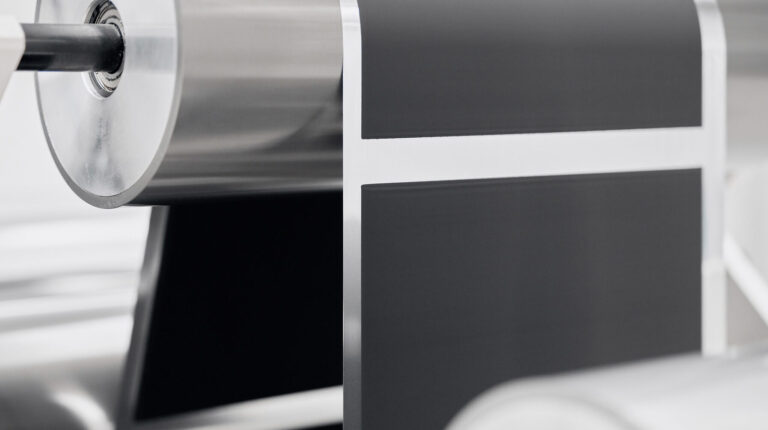
To achieve this goal, PowerCo and Koenig & Bauer have signed a joint development agreement. Together they will develop a roller press for powder coating electrodes on a large industrial scale. The process enables the manufacture of electrodes without wet coating and the subsequent need to dry them at high costs. With the new procedure, the most energy-intensive part of cell manufacturing and the use of chemical solvents are no longer required. PowerCo is already testing and optimizing the technology in a pilot line in one of its laboratories in northern Germany. As a printing specialist, Koenig & Bauer will develop a machine for industrial powder coating.

According to PowerCo estimates, the new technology has the potential to save about 30% of energy and 15% of floor space required and will therefore save hundreds of millions of euros each year. Frank Blome, CEO of PowerCo SE, remarked, “What the solid-state cell is to the product, dry coating is to production – a real game-changer. If scaled successfully, it will give us a unique position on the market and definite competitive advantages.”

In current industrial battery electrode production, the battery materials are mixed to a slurry with additives and liquid solvents. Afterward, they are coated onto foils of copper or aluminum, then dried and calendered.

PowerCo’s process allows the calendering of the powdery basic materials directly onto the foil, similar to a printing procedure. As a result, two of the four process steps in electrode manufacturing become obsolete. The powder coating can be applied onto the foil in an extremely fine and even manner; the resulting layer is about as thin as a hair. This guarantees excellent spatial energy density and a long lifespan, while improving the fast-charging ability of the battery.

The new technology reduces floor space required by 15% – an enormous saving potential. Per building block of a regular gigafactory with a production capacity of 20GWh, four parallel coating and drying lines can be saved, equaling an area of 7,000m2. As a result, the exterior length of the plant can be reduced by about 100m. Not having to operate the energy-intensive drying furnaces and suction systems is predicted to save the energy equivalent of the annual consumption of 40,000 private households. Furthermore, it is no longer necessary to use chemical solvents that have to be laboriously recycled at high energy costs in silo-like towers outside the plants.

Share. LinkedIn Twitter Facebook Email

Related Posts

Maserati Nettuno engine transformed into 480kW hydrogen race unit

May 29, 2026

Volvo Trucks expands future mobility strategy with multifuel combustion engine platforms

May 14, 2026

Major US hydrogen truck deployment announced by Toyota and Hyroad

May 7, 2026
LATEST NEWS

Ferrari unveils all-electric Luce

May 29, 2026

Scania under-cab battery module and Megawatt Charging System available for order

May 29, 2026

Maserati Nettuno engine transformed into 480kW hydrogen race unit

May 29, 2026

Receive breaking stories and features in your inbox each week, for free


Enter your email address:


Supplier Spotlights
  • Dontyne
Featured Listings
  • There are currently no listings to show.
Getting in Touch
  • Contact Us
  • Media Pack
  • Meet the Editors
  • Free Weekly E-Newsletter
Our Social Channels
  • LinkedIn
Related UKi Topics
  • Automotive Interiors
  • Automotive Testing
  • Autonomous Vehicle
  • Professional Motorsport
  • Tire Technology
  • Media Pack
© 2026 UKi Media & Events a division of UKIP Media & Events Ltd
  • Terms and Conditions
  • Privacy Policy
  • Cookie Policy
  • Notice and Takedown Policy

Type above and press Enter to search. Press Esc to cancel.