

Close Menu
  • News
      • Appointments
      • EV Powertrain
      • Emissions
      • Engine Components
      • Electronics
      • Facility Developments
      • Forced Induction
      • Fuel Cell Technologies
      • Fuels & Lubricants
      • Heavy-duty & Diesel Engine Technologies
      • Hybrid Powertrain Technologies
      • Industry Forecasting
      • Legislation
      • Materials & Surface Treatment
      • Metallurgy
      • Mild-hybrid & 48V Technologies
      • New powertrain
      • Partnerships, Investments & Acquisitions
      • Quality Control
      • Prototyping
      • Sustainable fuels
      • Testing
      • Traction Control Systems
      • Transmissions Technologies
      • Webinars
  • Features
  • Online Magazines
    • April 2026
    • January 2026
    • September 2025
    • June 2025
    • March 2025
    • January 2025
    • September 2024
    • Subscribe to Automotive Powertrain Technology
    • Transmission Technology International
    • Subscribe to Transmission Technology
  • Opinion
  • Supplier Spotlight
  • Webinars
Facebook X (Twitter) Instagram
  • Automotive Interiors
  • Automotive Testing
  • Autonomous Vehicle
  • Professional Motorsport
  • Tire Technology
  • Media Pack
LinkedIn
Subscribe
Automotive Powertrain Technology International
  • News
      • Appointments
      • EV Powertrain
      • Emissions
      • Engine Components
      • Electronics
      • Facility Developments
      • Forced Induction
      • Fuel Cell Technologies
      • Fuels & Lubricants
      • Heavy-duty & Diesel Engine Technologies
      • Hybrid Powertrain Technologies
      • Industry Forecasting
      • Legislation
      • Materials & Surface Treatment
      • Metallurgy
      • Mild-hybrid & 48V Technologies
      • New powertrain
      • Partnerships, Investments & Acquisitions
      • Quality Control
      • Prototyping
      • Sustainable fuels
      • Testing
      • Traction Control Systems
      • Transmissions Technologies
      • Webinars
  • Features
  • Online Magazines
    1. April 2026
    2. January 2026
    3. September 2025
    4. June 2025
    5. March 2025
    6. January 2025
    7. September 2024
    8. Subscribe to Automotive Powertrain Technology
    9. Transmission Technology International
    10. Subscribe to Transmission Technology
    Featured

    In this Issue – April 2026

    By Web TeamMay 1, 2026
    Recent

    In this Issue – April 2026

    May 1, 2026

    In this Issue – January 2026

    December 3, 2025

    In this Issue – September 2025

    September 25, 2025
  • Opinion
  • Supplier Spotlight
  • Webinars
LinkedIn Facebook
Subscribe
Automotive Powertrain Technology International
Electric Powertrain Technologies

Hyundai outlines electrification strategy to 2030

Lawrence ButcherBy Lawrence ButcherMarch 4, 20223 Mins Read
LinkedIn Twitter Facebook Email
Share
LinkedIn Twitter Facebook Email

Hyundai has released details of its strategic roadmap that plots its course toward electrification. The plan focuses on three key targets: strengthening the firm’s BEV lineups, optimizing its manufacturing operations and ensuring it is competitive in both hardware and software realms. A key target detailed in the strategy is to achieve BEV sales of 1.8 million units by 2030, with 7% global market share.

Company president and CEO Jaehoon Chang commented, “Hyundai is successfully accelerating its transition to electrification and becoming a global leader in EVs despite a challenging business environment caused by the global chip shortage and ongoing pandemic. Along with our seamless efforts to improve EV value, Hyundai Motor will continue to secure its business sustainability as a ‘Mobility Solutions Provider’ through advanced technologies of not only hardware but also software.”

As part of its plans, Hyundai hopes to introduce 17 BEV models, 11 Hyundai marque models along with six models from the Genesis luxury brand by 2030. The range will include three sedan models, six SUVs, one light commercial vehicle as well as one new type model. Genesis, meanwhile, will have a BEV lineup consisting of two passenger cars and four SUVs, including the Electrified GV70 launching this year. Starting in 2025, all newly launched models from Genesis will be electrified.

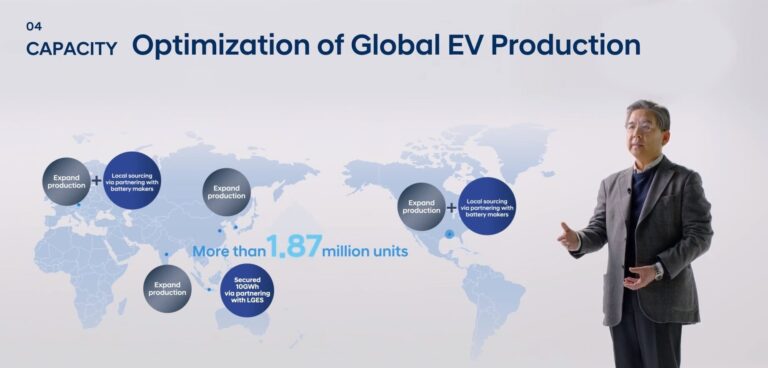
To achieve these goals, the company has set out to establish a high-efficiency manufacturing process for BEV production. The Hyundai Motor Global Innovation Center in Singapore (HMGICS) forms the cornerstone for this push, and will be tasked with building a human-centered manufacturing innovation platform. Hyundai states that the platform is expected to bring dramatic improvements in production efficiency through a flexible production system, advanced level automation and digital twin technology, and will be rolled out at plants globally in the future. Beyond existing BEV production facilities centered in Korea and the Czech Republic, Hyundai plans to gradually expand its BEV manufacturing bases, starting with an Indonesian plant that recently started operation.

As BEV production bases expand, the company is trying to increase the local procurement rate of batteries through strategic alliances with battery companies in major regions, including the USA, to secure sufficient battery supply. Through these alliances, the company expects to obtain more than 50% of its next-generation lithium batteries for BEVs starting in 2025.

Additionally, Hyundai says it will also diversify battery sourcing to consolidate the competitiveness of future BEVs. The company has secured sufficient battery supply to meet its sales targets by 2023. Hyundai plans to continue cooperation with various battery companies with an aim of securing 170 GWh of batteries for its models, including the Genesis luxury brand by 2030. Concurrent to these activities, the company will also continue development of next-generation battery technologies such as solid-state cells.

Underpinning future models will be a new Integrated Modular Architecture (IMA), evolved from the company’s electric global modular platform (E-GMP) that is the foundation of IONIQ 5 and GV60. The IMA is being developed to standardize not only a chassis but also battery system and motor.

Unlike the manufacturer’s existing BEV development system, which has different types of battery packs for each model, IMA-based vehicles will be equipped with standardized battery packs to attach flexibly regardless of the model to improve cost efficiency. The platform will also use a range of five traction motors, further aiding standardization.

Standardized five type of motors also will be installed on IMA according to model needs. This modular motor system can secure competitiveness in terms of cost and weight as well as motor efficiency.

Share. LinkedIn Twitter Facebook Email

Related Posts

Ferrari unveils all-electric Luce

May 29, 2026

Maserati Nettuno engine transformed into 480kW hydrogen race unit

May 29, 2026

BYD enters UK eLCV market with Dolphin Cargo e-Van

May 29, 2026
LATEST NEWS

Ferrari unveils all-electric Luce

May 29, 2026

Scania under-cab battery module and Megawatt Charging System available for order

May 29, 2026

Maserati Nettuno engine transformed into 480kW hydrogen race unit

May 29, 2026

Receive breaking stories and features in your inbox each week, for free


Enter your email address:


Supplier Spotlights
  • Iluka Resources
Featured Listings
  • There are currently no listings to show.
Getting in Touch
  • Contact Us
  • Media Pack
  • Meet the Editors
  • Free Weekly E-Newsletter
Our Social Channels
  • LinkedIn
Related UKi Topics
  • Automotive Interiors
  • Automotive Testing
  • Autonomous Vehicle
  • Professional Motorsport
  • Tire Technology
  • Media Pack
© 2026 UKi Media & Events a division of UKIP Media & Events Ltd
  • Terms and Conditions
  • Privacy Policy
  • Cookie Policy
  • Notice and Takedown Policy

Type above and press Enter to search. Press Esc to cancel.