
Close Menu
  • News
      • Appointments
      • EV Powertrain
      • Emissions
      • Engine Components
      • Electronics
      • Facility Developments
      • Forced Induction
      • Fuel Cell Technologies
      • Fuels & Lubricants
      • Heavy-duty & Diesel Engine Technologies
      • Hybrid Powertrain Technologies
      • Industry Forecasting
      • Legislation
      • Materials & Surface Treatment
      • Metallurgy
      • Mild-hybrid & 48V Technologies
      • New powertrain
      • Partnerships, Investments & Acquisitions
      • Quality Control
      • Prototyping
      • Sustainable fuels
      • Testing
      • Traction Control Systems
      • Transmissions Technologies
      • Webinars
  • Features
  • Online Magazines
    • April 2026
    • January 2026
    • September 2025
    • June 2025
    • March 2025
    • January 2025
    • September 2024
    • Subscribe to Automotive Powertrain Technology
    • Transmission Technology International
    • Subscribe to Transmission Technology
  • Opinion
  • Supplier Spotlight
  • Webinars
Facebook X (Twitter) Instagram
  • Automotive Interiors
  • Automotive Testing
  • Autonomous Vehicle
  • Professional Motorsport
  • Tire Technology
  • Media Pack
LinkedIn
Subscribe
Automotive Powertrain Technology International
  • News
      • Appointments
      • EV Powertrain
      • Emissions
      • Engine Components
      • Electronics
      • Facility Developments
      • Forced Induction
      • Fuel Cell Technologies
      • Fuels & Lubricants
      • Heavy-duty & Diesel Engine Technologies
      • Hybrid Powertrain Technologies
      • Industry Forecasting
      • Legislation
      • Materials & Surface Treatment
      • Metallurgy
      • Mild-hybrid & 48V Technologies
      • New powertrain
      • Partnerships, Investments & Acquisitions
      • Quality Control
      • Prototyping
      • Sustainable fuels
      • Testing
      • Traction Control Systems
      • Transmissions Technologies
      • Webinars
  • Features
  • Online Magazines
    1. April 2026
    2. January 2026
    3. September 2025
    4. June 2025
    5. March 2025
    6. January 2025
    7. September 2024
    8. Subscribe to Automotive Powertrain Technology
    9. Transmission Technology International
    10. Subscribe to Transmission Technology
    Featured

    In this Issue – April 2026

    By Web TeamMay 1, 2026
    Recent

    In this Issue – April 2026

    May 1, 2026

    In this Issue – January 2026

    December 3, 2025

    In this Issue – September 2025

    September 25, 2025
  • Opinion
  • Supplier Spotlight
  • Webinars
LinkedIn Facebook
Subscribe
Automotive Powertrain Technology International
Electric Powertrain Technologies

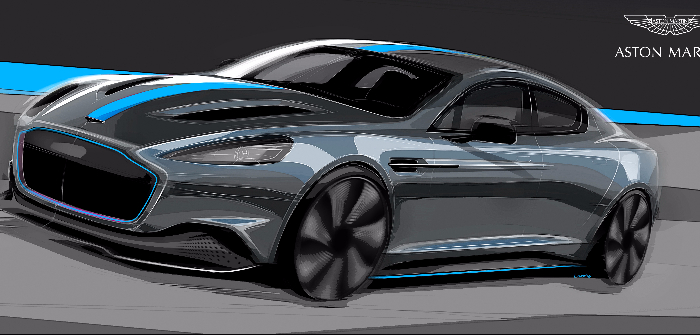
Aston Martin unveils its first all-electric vehicle

Dean SlavnichBy Dean SlavnichJune 27, 20173 Mins Read
LinkedIn Twitter Facebook Email
Share
LinkedIn Twitter Facebook Email

Aston Martin has confirmed that its all-electric RapidE will enter production in 2019. Set for a limited production run of 155 cars, the RapidE is the brand’s first all-electric model. As such, it spearheads development of the brand’s low- and zero-emission vehicle strategy laid out by Aston Martin’s president and CEO, Dr. Andy Palmer, in the company’s Second Century Plan.

RapidE sees a continuation of the collaboration with Williams Advanced Engineering who worked on the original RapidE Concept. Based in Grove, Oxfordshire, Williams Advanced Engineering will assist Aston Martin with the task of engineering integration.

Based upon the forthcoming Rapide AMR concept, RapidE will deliver four-door sports car looks and dynamics of the Rapide S powered by an all-electric powertrain replacing the six-liter V12 engine. More information will be revealed about the RapidE’s all-electric powertrain in due course. The instantaneous delivery characteristics of electric motors means the RapidE will offer a unique driving experience of a kind not experienced before in an Aston Martin.

“Having unveiled the RapidE Concept back in October 2015 we reach another milestone with the confirmation that we are now putting the first all-electric Aston Martin into production,” explained Dr. Palmer. “RapidE represents a sustainable future in which Aston Martin’s values of seductive style and supreme performance don’t merely co-exist alongside a new zero-emission powertrain, but are enhanced by it. The internal combustion engine has been at the heart of Aston Martin for more than a century, and will continue to be for years to come. RapidE will showcase Aston Martin’s vision, desire and capability to successfully embrace radical change, delivering a new breed of car that stays true to our ethos and delights our customers.”

“Williams Advanced Engineering has always endeavoured to work collaboratively with its customers to meet their sustainability challenges and find energy efficient solutions,” added Paul McNamara, technical director at Williams Advanced Engineering. “For today’s car manufacturers, this is particularly important as legislation demands more energy efficient vehicles. This project with Aston Martin will draw on the extensive battery and EV experience we have accumulated and we are extremely pleased to be supporting this prestigious British company with their future electrification strategy.”

Elsewhere, Aston Martin confirmed that its DB11 sports car is now available with a 4.0-liter twin-turbocharged V8. Set to sit alongside and ‘complement’ the DB11’s existing 5.2-litre twin turbocharged V12, Aston Martin states that the new AMG-sourced powerplant has ‘provided the opportunity to reveal more of the DB11’s sporting character, while expanding its global appeal with a combination of exceptional performance and improved efficiency’.

Producing 510PS (503BHP) and 675Nm of torque, the V8 takes the DB11 from 0-62mph in just 4.0sec and on to a top speed of 187mph. This performance is matched by CO2 emissions of 230g/km and an EU Combined fuel economy figure of 28.5mpg. This new V8 derivative brings further significant benefits in markets where car taxation policy is structured around engine capacity, such as China.

Aston Martin’s engineering team has tailored the V8 engine perfectly for its application in the DB11 with bespoke air intake, exhaust and wet sump lubrication systems.

Electronic calibration of the V8 engine has included creating new ECU software and reprogramming the engine and throttle mapping. The slimline wet sump system enables the V8 to be mounted as low as possible for an optimised centre-of-gravity. The V8 engine is also lighter and more compact than the V12, which contributes to a saving of 115kg and a kerbweight of 1760kg.

Share. LinkedIn Twitter Facebook Email

Related Posts

Ferrari unveils all-electric Luce

May 29, 2026

BYD enters UK eLCV market with Dolphin Cargo e-Van

May 29, 2026

Mercedes‑AMG presents all-electric GT 4‑Door Coupe

May 21, 2026
LATEST NEWS

Ferrari unveils all-electric Luce

May 29, 2026

Scania under-cab battery module and Megawatt Charging System available for order

May 29, 2026

Maserati Nettuno engine transformed into 480kW hydrogen race unit

May 29, 2026

Receive breaking stories and features in your inbox each week, for free


Enter your email address:


Supplier Spotlights
  • TLX Technologies
Featured Listings
  • There are currently no listings to show.
Getting in Touch
  • Contact Us
  • Media Pack
  • Meet the Editors
  • Free Weekly E-Newsletter
Our Social Channels
  • LinkedIn
Related UKi Topics
  • Automotive Interiors
  • Automotive Testing
  • Autonomous Vehicle
  • Professional Motorsport
  • Tire Technology
  • Media Pack
© 2026 UKi Media & Events a division of UKIP Media & Events Ltd
  • Terms and Conditions
  • Privacy Policy
  • Cookie Policy
  • Notice and Takedown Policy

Type above and press Enter to search. Press Esc to cancel.