

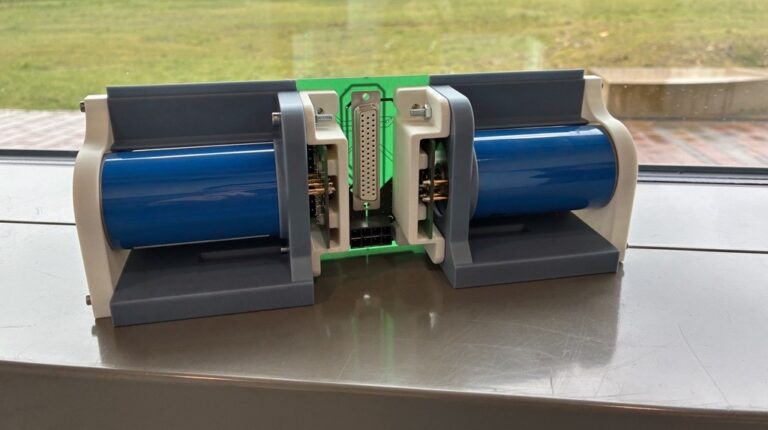
The RESiLiTE (Robust, Economical, Silicon-rich, Lightweight and Thermally Efficient Battery Packs) project, co-funded by Horizon Europe, has received cell samples at Kautex in Bonn, Germany. This marks a key step toward developing battery packs for automotive applications, with potential expansion into aviation.
The cell samples are currently undergoing testing at RWTH Aachen, which will generate data that will help fine-tune and optimize the sensing and control features of the battery management system (BMS). Securing these samples is a major step forward, as it forms the foundation for optimizing battery charge/discharge timing (high C-rates), ensuring efficient operation without causing damage or shortening battery lifespan.
The project, which began in July 2025, has made significant progress over the past year. Notably, the technical system-level requirements for the battery packs have been successfully defined. Work has also been ongoing on the vehicle and battery architecture, as well as the design and sizing of the full battery pack. RESiLiTE has also been developing the BMS, safety functionalities and fast-charging capabilities.
In 2026, the project will focus on finalizing the design and architecture of the battery pack.
Stefano Piacquadio, project coordinator at Kautex, said, “The project is on track to achieve all its KPIs by developing a prototype that is ready for industrialization. Together with our partners, we are advancing the state of the art in battery pack technology, developing industrializable architectures with exceptional packaging efficiency, high C-rate capability and advanced diagnostics to support these innovations.”
Related news, Škoda becomes Volkswagen Group’s largest BEV battery producer