

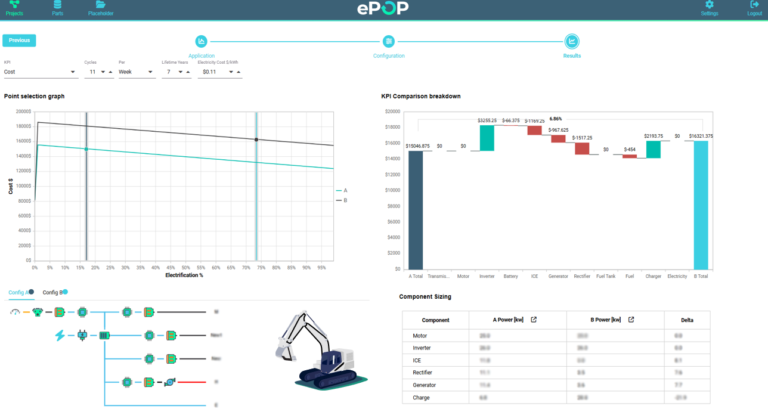
Being able to quickly find the ideal powertrain solution for a given project is a boon for any manufacturer, be it in automotive or other sectors such as off-highway. Virtual tools have already revolutionized the development process, reducing the number of prototypes required and pushing the need for physical parts further down the line. However, many of the processes used are somewhat disjointed, making it difficult to efficiently find the optimum combination of components from an overall system perspective, taking into account performance as well as factors such as costs and, ever more importantly, sustainability. ZeBeyond, a UK-based software company, is looking to streamline the process and give engineers an all-in-one tool to quickly arrive at the optimum propulsion package for their specific applications.
Over the past five years, ZeBeyond has been honing its ePOP tool in automotive. However, as CTO Bence Falvy explains, the off-highway sector has shown potential for even greater relative gains. “In the automotive industry, high production volumes justify the investment in high-fidelity, multidimensional simulations for each new product iteration,” he says. “These detailed analyses are supported by extensive data availability and standardized load cases.
“In contrast, the off-highway sector operates with significantly lower volumes and far greater application diversity. Here, the lack of accurate load cycle data and the sheer number of possible powertrain configurations often make such detailed analysis impractical (or economically unviable) without better simulation frameworks and data acquisition strategies.”
Simplifying the complex
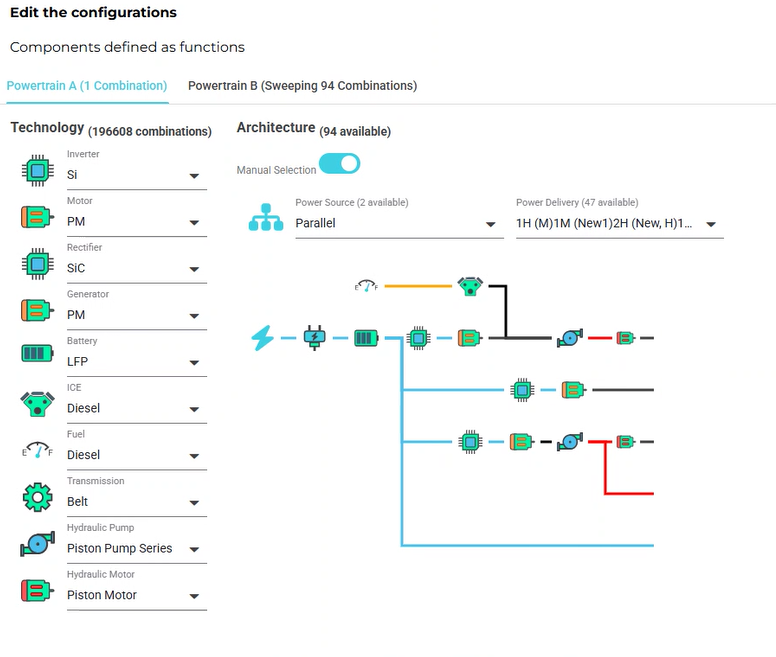
The concept of ePOP is simple, even if its implementation is anything but. The tool enables engineers to input their end requirements for a powertrain and outputs a variety of options for how best to meet those requirements. For example, given a particular drive cycle and package requirement, would an axial or radial flux motor be preferred, or an ASM or PSM? Compared with passenger cars, the level of system complexity in the off-highway market can be very high, but the starting point from an efficiency perspective is often lower, making it possible to achieve impressive improvements over existing solutions.
“Traditional powertrain sizing in the off-highway industry has largely been driven by peak power requirements, with internal combustion engines serving as the default solution,” explains Falvy. “However, many of these applications exhibit high peak-to-average power ratios — a characteristic that opens significant opportunities for hybridization or even full electrification, depending on the operational profile. By matching energy sources more intelligently to the actual demand patterns, it’s possible to achieve substantial gains in efficiency.
“Designing and sizing hybrid powertrains is inherently complex, as it extends beyond traditional power-based considerations to include energy management and time-domain dynamics. This multidimensional design challenge requires advanced tools and methodologies. The off-highway industry has a unique opportunity to accelerate hybrid system integration by adopting best practices from the automotive sector, where high- dimensional analysis techniques have matured over years of intensive development and high-volume deployment.”
Controlling powertrain costs
While efficiency is an important selling point in automotive, total cost of ownership (TCO) is king in the off-highway and commercial vehicle arena. Because ZeBeyond’s tools encompass the entire product lifecycle, they offer the opportunity to dramatically affect this metric.
It is this aspect that has enthused CEO Wiktor Dotter. “That’s where I’m so excited about off- highway,” he says. “With passenger cars, you’re not selling to a fleet, you’re selling to households. If you’re selling to a fleet and you can deliver improved efficiency, you’re saving dollars, you’re saving gallons of fuel and you’re selling uptime. If you can size a portfolio of machines to a mine, and say, ‘Okay, it is five times the cost per component, but you will double your uptime,’ it’s a no-brainer.”
Central to these potential improvements is a proper understanding of the end use environment for the powertrain, be it an excavator or even a stationary generator unit. “In hybrid powertrains, the optimal balance between battery capacity, internal combustion engine size and electric motor power is critical to maximizing energy savings,” says Falvy. “When correctly sized and integrated, these systems can significantly reduce fuel consumption and operating costs, directly contributing to a lower total cost of ownership.”
Notably, ZeBeyond’s off-highway toolset allows not only for the main powertrain to be defined and refined but also for the myriad auxiliary drives, such as hydraulics, to be optimized. “You could be talking about a hydraulic load, or a fan that needs to run for a cooling system,” highlights Falvy. “You can end up with a large list of various power types, hydraulic, electric, mechanical, rotational and so on. Compared with the automotive solution, where we are just looking to drive the wheels, in the off-highway industry, while the fidelity of the individual components is reduced, the fidelity and complexity of the overall solution explodes. You have a very large number of options to consider, and we are developing various ways of addressing that, allowing customers to understand the hundreds or even thousands of options available, ascertain which is best and arrive at a package with the best TCO, or the lightest solution, of any other KPI they choose.”
 ZeBeyond tends to work with system integrators and engineers to ascertain their high-level requirements for a particular project. These are then used to create measurable output metrics, such as power requirement versus time. Unlike automotive, where there are already established test cycles such as WLTP, very few such cycles exist in off-highway, particularly where a piece of plant may be produced in very low numbers or even be unique. In such cases, Falvy says the company will work with clients to establish baseline use cycles from scratch, with the tool enabling users to create individual cycles across a workday for each power output requirement.
ZeBeyond is constantly working to broaden the data to which its tools have access. “We are collaborating with suppliers of components, for example internal combustion engines and battery suppliers, and integrating their catalogs into our tool,” notes Falvy. “From there, we can go into the real world and say, ‘Okay, I know you would like a 25kW ICE engine, for example, but you may only have a 30kW and 20kW available.’ We can then ask the tool which of those would be the best pick as it is possible one will be better than another.”
With relentless pressure on development timelines and industry-wide hesitation to commit to major electrification projects, manufacturers are increasingly seeing ZeBeyond’s software as essential. By drastically lowering barriers through software simulation, its tools quickly reveal where electrification makes business sense and where it doesn’t, enabling faster decisions and freeing resources to refine final products aligned closely with customer needs.