
Close Menu
  • News
      • Appointments
      • EV Powertrain
      • Emissions
      • Engine Components
      • Electronics
      • Facility Developments
      • Forced Induction
      • Fuel Cell Technologies
      • Fuels & Lubricants
      • Heavy-duty & Diesel Engine Technologies
      • Hybrid Powertrain Technologies
      • Industry Forecasting
      • Legislation
      • Materials & Surface Treatment
      • Metallurgy
      • Mild-hybrid & 48V Technologies
      • New powertrain
      • Partnerships, Investments & Acquisitions
      • Quality Control
      • Prototyping
      • Sustainable fuels
      • Testing
      • Traction Control Systems
      • Transmissions Technologies
      • Webinars
  • Features
  • Online Magazines
    • April 2026
    • January 2026
    • September 2025
    • June 2025
    • March 2025
    • January 2025
    • September 2024
    • Subscribe to Automotive Powertrain Technology
    • Transmission Technology International
    • Subscribe to Transmission Technology
  • Opinion
  • Events
  • Supplier Spotlight
  • Webinars
Facebook X (Twitter) Instagram
  • Automotive Interiors
  • Automotive Testing
  • Autonomous Vehicle
  • Professional Motorsport
  • Tire Technology
  • Media Pack
LinkedIn
Subscribe
Automotive Powertrain Technology International
  • News
      • Appointments
      • EV Powertrain
      • Emissions
      • Engine Components
      • Electronics
      • Facility Developments
      • Forced Induction
      • Fuel Cell Technologies
      • Fuels & Lubricants
      • Heavy-duty & Diesel Engine Technologies
      • Hybrid Powertrain Technologies
      • Industry Forecasting
      • Legislation
      • Materials & Surface Treatment
      • Metallurgy
      • Mild-hybrid & 48V Technologies
      • New powertrain
      • Partnerships, Investments & Acquisitions
      • Quality Control
      • Prototyping
      • Sustainable fuels
      • Testing
      • Traction Control Systems
      • Transmissions Technologies
      • Webinars
  • Features
  • Online Magazines
    1. April 2026
    2. January 2026
    3. September 2025
    4. June 2025
    5. March 2025
    6. January 2025
    7. September 2024
    8. Subscribe to Automotive Powertrain Technology
    9. Transmission Technology International
    10. Subscribe to Transmission Technology
    Featured

    In this Issue – April 2026

    By Web TeamMay 1, 2026
    Recent

    In this Issue – April 2026

    May 1, 2026

    In this Issue – January 2026

    December 3, 2025

    In this Issue – September 2025

    September 25, 2025
  • Opinion
  • Events
  • Supplier Spotlight
  • Webinars
LinkedIn Facebook
Subscribe
Automotive Powertrain Technology International
Features

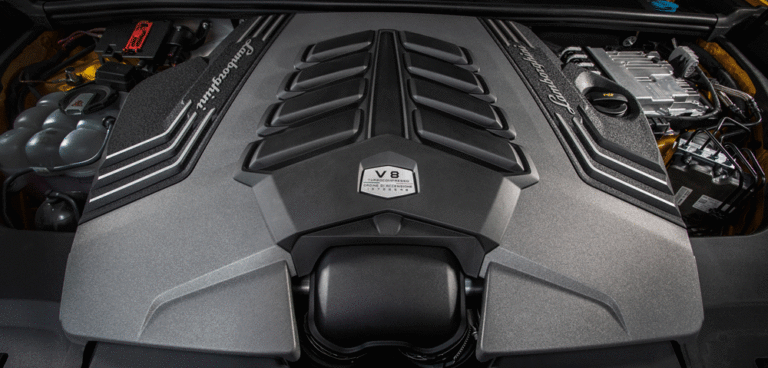
Engines on test: Lamborghini Urus 4.0 V8

Sam PettersBy Sam PettersApril 11, 20192 Mins Read
LinkedIn Twitter Facebook Email
Share
LinkedIn Twitter Facebook Email

For Lamborghini, trying its hand at an SUV was always going to be a risky business. After all, it’s been 33 long years since the LM002 rolled off of the production ramp in Bologna.

The concept of a supersport SUV has been rather uncharted territory, and questions were always going to be raised about whether Lamborghini – and its first turbocharged engine – was going to be able to inject that same supercar emotion into an SUV that is just shy of 2.2 metric tons. The answer, in short, is yes.

The twin-turbo-assisted 4-liter V8 engine develops 650ps at the 6,800rpm redline and a massive 850Nm of torque from just 2,250rpm, and you feel all of that power. Despite its substantial size and curb weight, the Urus is brutally quick, hitting 100km/h in 3.2 seconds, 200km/h in 12.8 seconds, and then on to a top speed of 305km/h.

Yet, during normal driving the engine is subtle and the Urus is capable of being restrained. There are none of the minor annoyances that can come with using a Lambo for everyday driving. Steering is light, the SUV is easy to maneuver, and you can just about hear the V8 rumbling away in the background.

But that completely changes when in Sport or Corsa modes. Accelerate and all eight cylinders bang and crack on the overrun, constantly reminding you that you are sitting behind the wheel of one of Bologna’s finest. Yes, sound augmentation helps. A symposer boosts the natural frequencies of the intake system, but it’s very easy to forget about that.

If you’re buying a Lamborghini, emissions and fuel consumption aren’t likely to be the first things on your mind. And that’s a good thing – emitting 325g/km and averaging 12.7 l/100km (22.2mpg), its footprint isn’t the cleanest. But as with any of the Urus’s very minor flaws, you’ll happily ignore it when you hear the V8 pop.

Share. LinkedIn Twitter Facebook Email

Related Posts

Study reveals what EV buyers really ask about batteries

November 12, 2025

New self-assembling material could be the key to recyclable EV batteries

September 4, 2025

Hyundai/GM alliance powers forward with five all-new vehicles

August 12, 2025
LATEST NEWS

Renault introduces LPG bi-fuel Clio that delivers up to 1,450km range

May 7, 2026

UK consortium secures funding for ReCAM lithium-ion battery recycling project

May 7, 2026

BorgWarner wins turbocharger contracts with two European OEMs

May 7, 2026

Receive breaking stories and features in your inbox each week, for free


Enter your email address:


Supplier Spotlights
  • International Products Corporation
Featured Listings
  • There are currently no listings to show.
Getting in Touch
  • Contact Us
  • Media Pack
  • Meet the Editors
  • Free Weekly E-Newsletter
Our Social Channels
  • LinkedIn
Related UKi Topics
  • Automotive Interiors
  • Automotive Testing
  • Autonomous Vehicle
  • Professional Motorsport
  • Tire Technology
  • Media Pack
© 2026 UKi Media & Events a division of UKIP Media & Events Ltd
  • Terms and Conditions
  • Privacy Policy
  • Cookie Policy
  • Notice and Takedown Policy

Type above and press Enter to search. Press Esc to cancel.